









Chat&Messenger Web Conference This section explains the amount of traffic that will be incurred on the internal and inter-office networks when this is done.
Audio and Camera・Comparison table for document sharing
When conducting a web conference, the following traffic will be generated on your router, etc.
| Number of users (Unit: Mbps (Average value) | 5人 | 10 people | 20 people | 50 people | 100 people | 150 people |
|---|---|---|---|---|---|---|
| Audio only | 1.5 | 5.0 | 14.0 | |||
| Audio and Camera | 3.0 | 8.0 | 26.0 | |||
| 1 user audio and documents (others audio and camera off) | 1.8 | 6.0 | 14.0 | 60.0 | 90.0 | 110.0 |
- Each organization should establish its own policy on how many web conferencing sessions can be used simultaneously, taking into consideration internal router limitations within the organization.
- Facility Reservation Function Large-scale meetings can be controlled by reserving and conducting them as a whole using the
- On-premises CAMserver When measuring, use the OpenJDK Platform Binary network usage fee in Task Manager as a guide.

The approximate amount of communication required on the client side (one PC) is
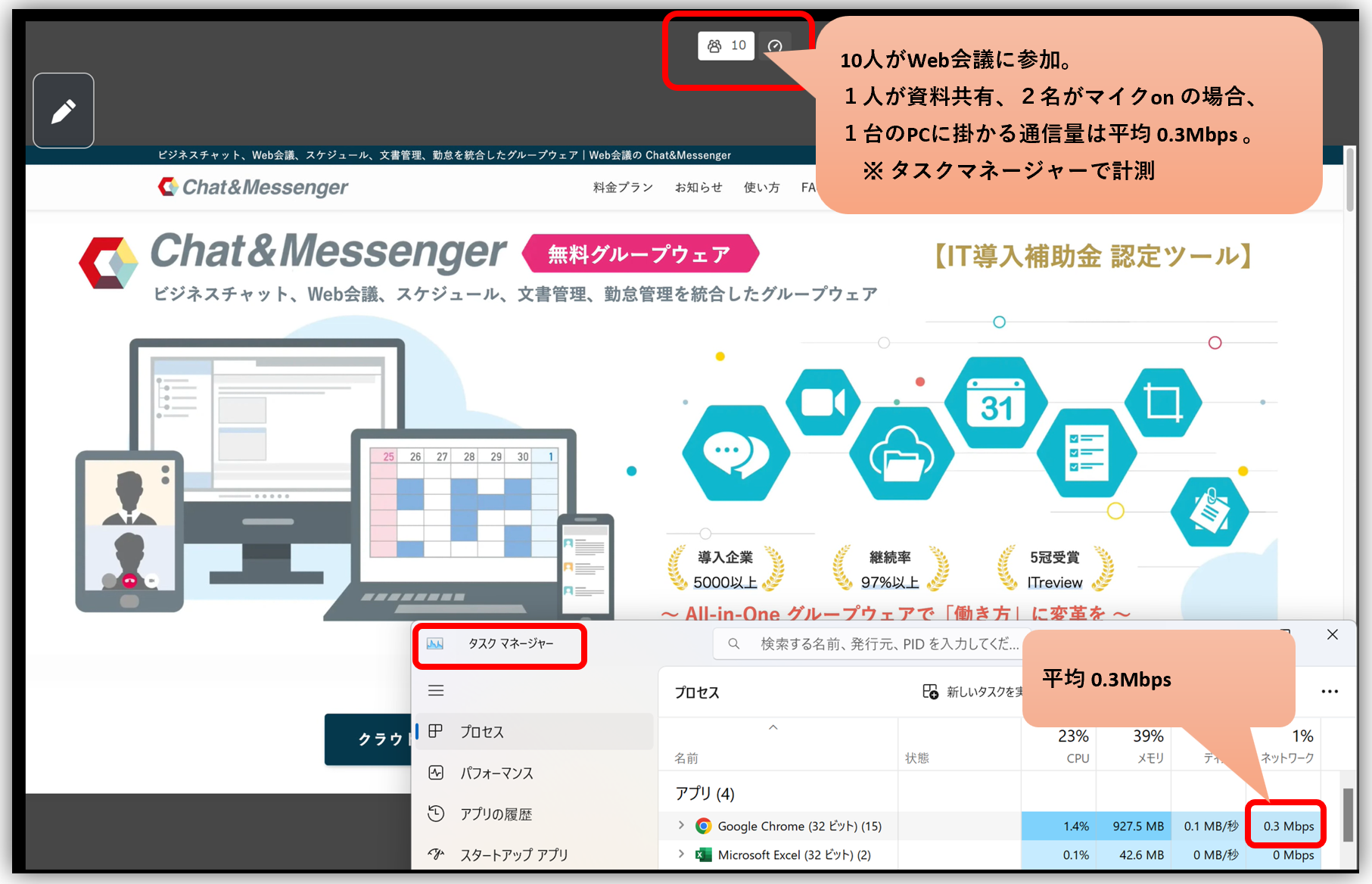
In this case, the easiest way is to measure using Windows Task Manager. The following shows that when 10 people participate in a web conference and one person shares materials, the average communication amount per PC is about 0.3Mbps.
Maximum number of simultaneous connections
- The maximum number of participants per meeting room is 250.
- A rough estimate of the maximum server specifications is around 16 CPU cores and 32GB of memory.
- For a meeting with approximately 250 participants, under the conditions of one person sharing documents, other participants having their cameras off, and several having their microphones on, the average data usage on the meeting server is approximately 200Mbps.
- For large-scale meetings, it is recommended to limit camera-on participants to only those who need it, with a maximum of approximately 50 participants per meeting.
- Example 1) In a meeting with 150 participants, approximately 50 people will have their cameras on, while the rest will have their cameras off.
- Example 2) Even in large-scale conferences with over 150 participants, up to a maximum of 250, cameras are primarily turned on for speakers and presenters, while other participants mainly watch.
- The camera footage is,This generates more than twice the network traffic compared to document sharing.This can happen because, in document sharing, the screen remains still for long periods, making compression and frame sparsening by the AV1 codec more effective, whereas camera footage constantly changes. To stably handle a large number of simultaneous connections with a limited number of servers, the number of participants in the meeting is less important than the number of participants themselves.It is important to appropriately limit the number of users who have their cameras turned on.
- By configuring multiple conference servers, it is possible to distribute processing across multiple conference rooms and expand the total number of simultaneous connections for the entire system.
- The number of simultaneous connections that can be accommodated depends on the traffic limits of the routers and network lines on the data center side.
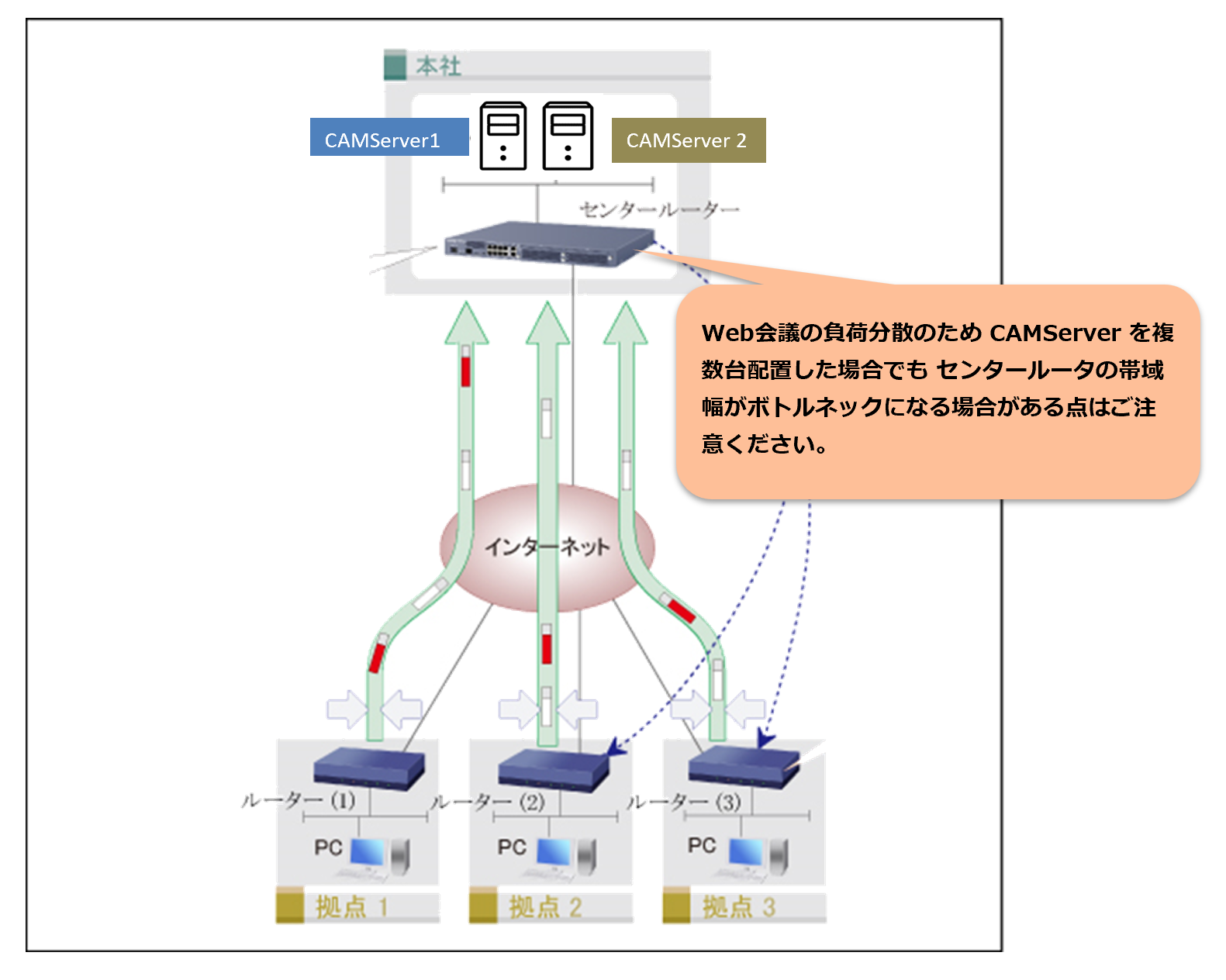
- By distributing conference servers across multiple data centers, the system as a whole is not dependent on a fixed limit on the number of simultaneous connections, and can be scaled according to the required size.
Adjustment of resolution and frame rate
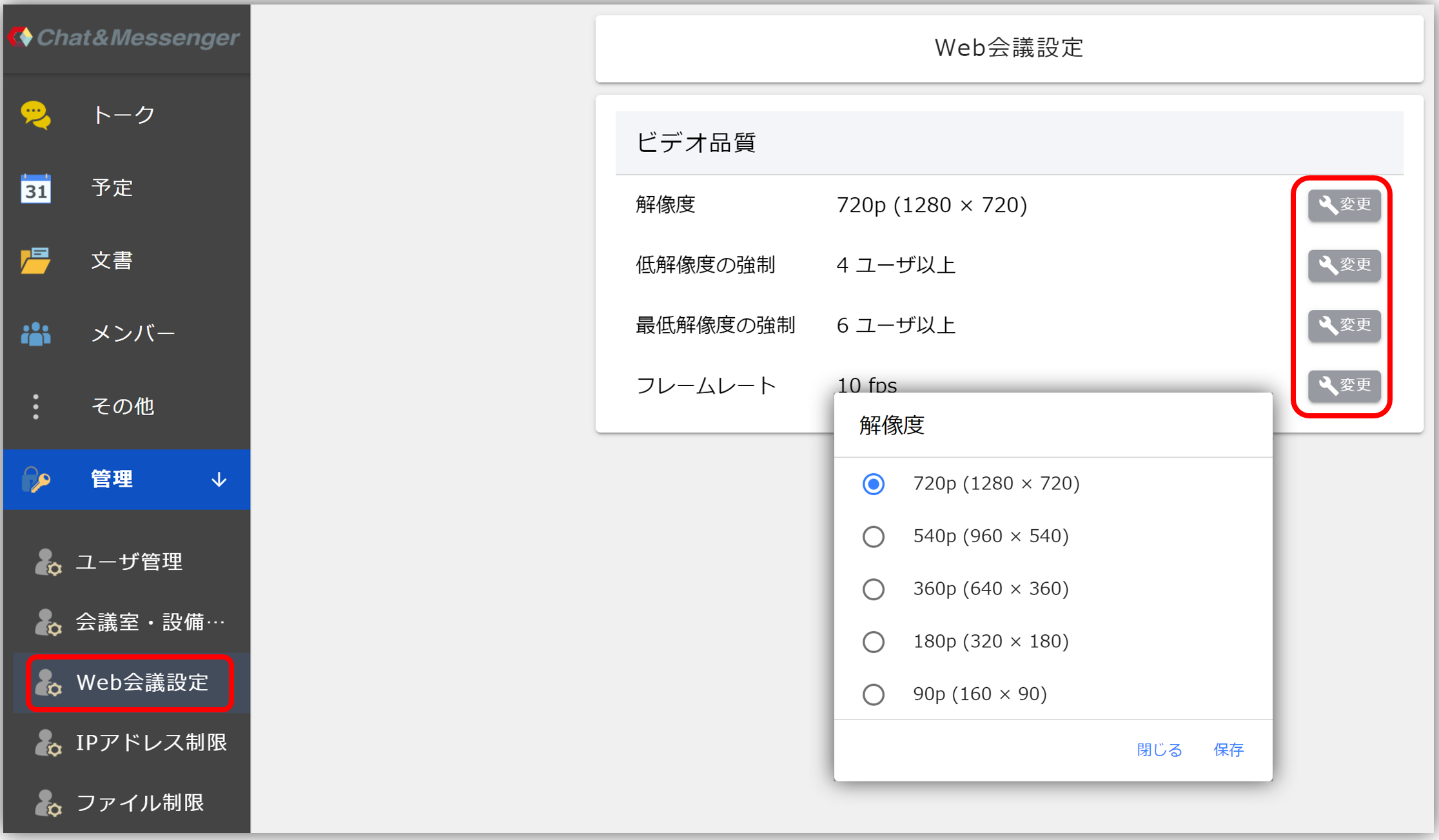
For Chat&Messenger web conferences, camera resolution is limited to low traffic by default for 5 or 10 users. To change this, go to the "Web Conference SettingsPlease use "
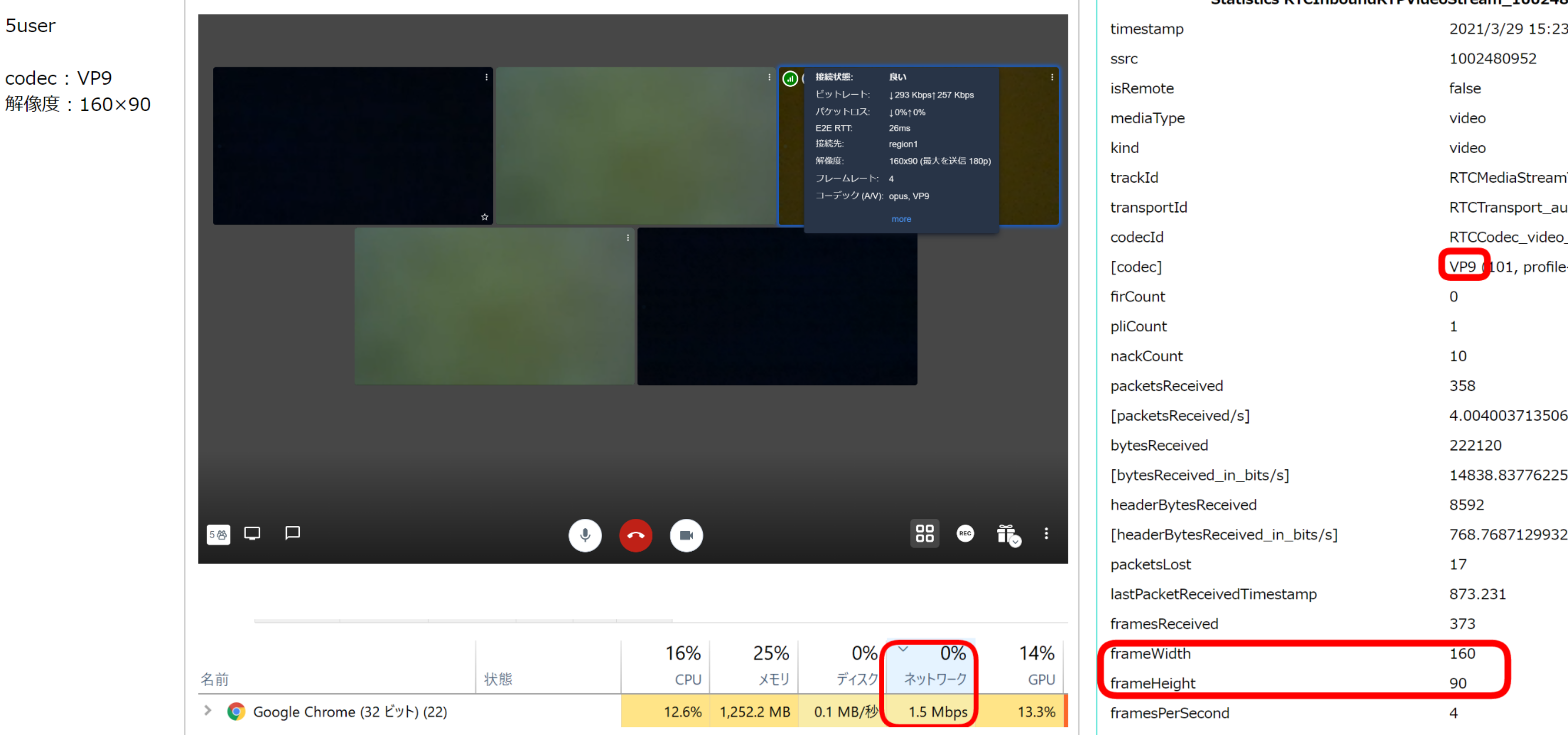
Achieving the lowest traffic in the industry
Bitrate guideline
Bitrate guideline calculation formula when camera is used
This section introduces a formula for calculating the bitrate (kbps), which is the amount of data transmitted over the network by the sender (encoder). In real-time communications such as WebRTC, the bitrate is dynamically adjusted according to bandwidth limitations, network conditions, and the movement of people, but the general guideline is as follows.
Bit rate (bps) ≒ Number of resolution pixels × Frame rate × Motion factor × Compression factor
- Resolution: 180-1080p is recommended. 180p is 320 x 180, which is 57,600 pixels.
- Frame rate: 5 to 30 fps
- Motion coefficient: The amount of change between frames in the video, such as human movement. Low: 0.07 - High: 0.12
- Compression factor... AV1 (high compression codec): Approximately 0.05 to 0.08 is a good guideline.
The average video bit rate (kbps) sent by the sender to the network is as follows, and the receiver basically consumes the same amount of bandwidth (one sender and multiple receivers depending on the number of participants).
| Resolution (size) | Camera footage (people)/ 10fps | Document sharing (static system) / 10fps | Guidelines for use |
|---|---|---|---|
| 180p (320x180) | 28-42 kbps | 10-18 kbps | Minimum bandwidth for multi-person meetings / lightweight document sharing |
| 360p (640x360) | 110-160 kbps | 35-60 kbps | General meeting / PowerPoint sharing |
| 540p (960×540) | 260-360 kbps | 90-140 kbps | High-quality meetings for small groups / Showing documents in detail |
| 720p (1280×720) | 470-650 kbps | 160-240 kbps | Clean and easy-to-use document sharing/lecture delivery |
| 1080p (1920×1080) | 1,040–1,440 kbps | 350-500 kbps | High-definition document sharing and recording quality |