









About the Access Log
You can record logs of clients accessing on-premises CAMServer.
There are two ways to view access logs: one is to view them from the management screen, and the other is to record them in text format.
Access log of the management screen
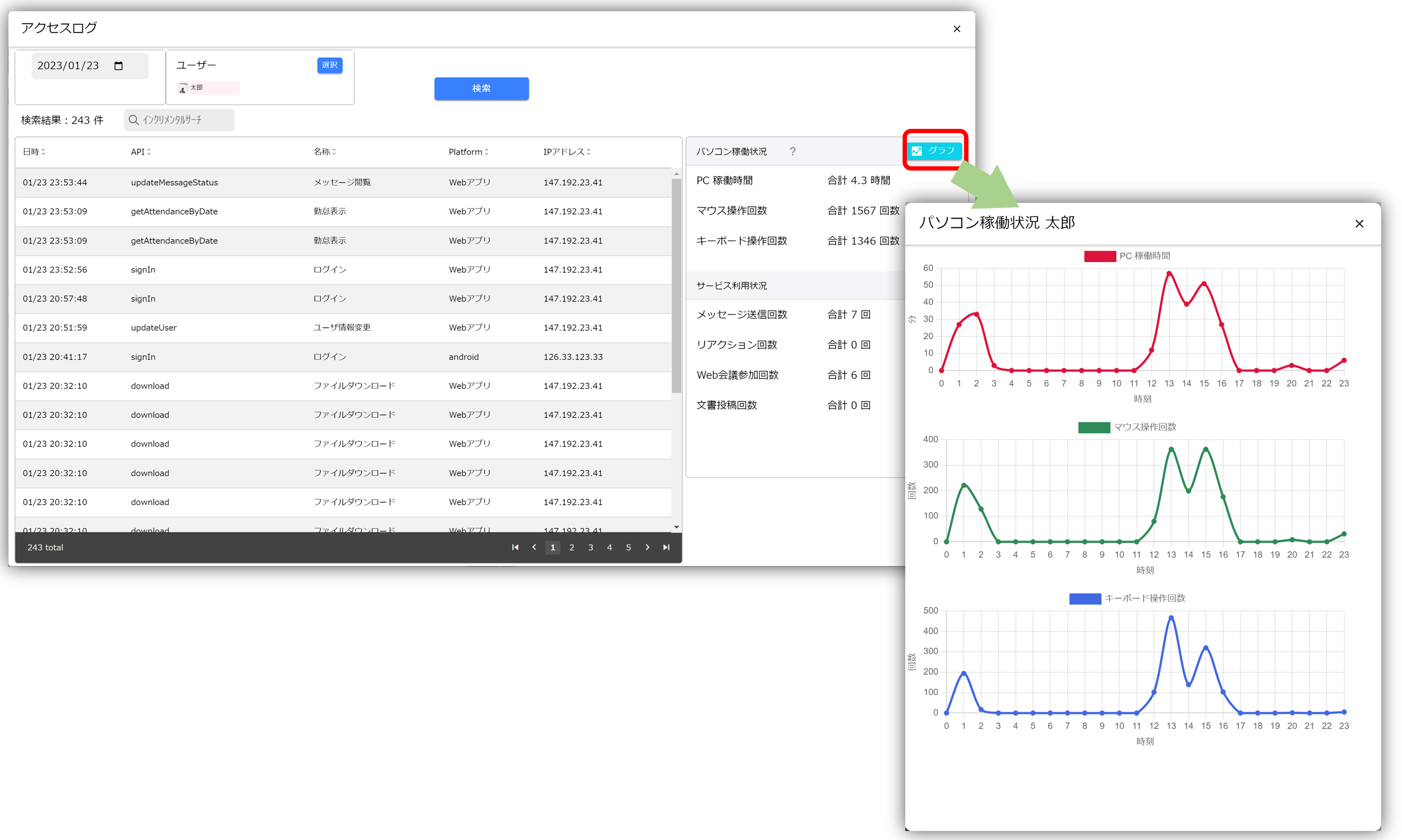 | Access logs for each user can be viewed on the management screen. |
- Access logs for the management screen are available for Cloud Enterprise and On-premise Ultimate.
- PC utilization status can be viewed when time and attendance management is enabled.
Text access log
Recording Method
- CAMServer stop
CAMServer/boot.iniAdd the following section to the file# Logs each HTTP access
cam.enableServerAccessLog=true
# (Optional). Add the email address used for login authentication to the above log (the email address will be partially masked before being recorded).
cam.enableServerAccessLogEmail=true- CAMServer startup
Log Storage Location
Once the above settings are completed CAMServer/sys/logs/YYYYMM_application0.log Access logs are recorded in the file.
- YYYYMM represents the year and month in which CAMServer was started.
- Log files are rotated in 50MB increments, with filename 0 in the YYYYMM_application0.log series being the currently active log file. Files with lower sequential numbers are the newest log files for the current month.
- boot.iniDelete log filesIt will be automatically deleted after the specified period.
What is recorded
Access logs are logged in the following format
Date:[INFO]:CAMServlet :Request /CAMServer/API Endpoint Client IP Masked Email Part of User ID Part of Session ID Client Terminal Identifier (web|electron|android|ios)
2022/09/10 13:57:09:[INFO]:CAMServlet :Request /CAMServer/getpublickey 192.168.1.XX tes*ou*an*be*te*t*co* 1gh7pgnovpss 856C9E2 web
2022/09/10 13:57:09:[INFO]:CAMServlet :Request /CAMServer/getack 192.168.1.XX tes*ou*an*be*te*t*co* 1gh7pgnovpss 856C9E2 web
2022/09/10 13:57:09:[INFO]:CAMServlet :Request /CAMServer/serverInfo 192.168.1.XX tes*ou*an*be*te*t*co* 1gh7pgnovpss 856C9E2 web
2022/09/10 13:57:09:[INFO]:CAMServlet :Request /CAMServer/signIn 192.168.1.XX tes*ou*an*be*te*t*co* 1gh7pgnovpss 856C9E2 web
2022/09/10 13:57:10:[INFO]:CAMServlet :Request /CAMServer/getTalkList 192.168.1.XX tes*ou*an*be*te*t*co* 1gh7pgnovpss 856C9E2 web
2022/09/10 13:57:10:[INFO]:CAMServlet :Request /CAMServer/getUserPref 192.168.1.XX tes*ou*an*be*te*t*co* 1gh7pgnovpss 856C9E2 web
2022/09/10 13:57:10:[INFO]:CAMServlet :Request /CAMServer/getLatestEntities 192.168.1.XX tes*ou*an*be*te*t*co* 1gh7pgnovpss 856C9E2 web
Log monitoring
In order to detect an abnormality that occurs in CAMServer from the log, the log file output by CAMServer (CAMServer/sys/logs/YYYYMM_application0.log) should be monitored with a log monitoring tool.
In most cases [SEVERE] Please monitor it with a monitoring tool.
WARNING level
- Content: Output in case of authentication error, API access error, or unexpected error on the client side
- Impact: Harmless in most cases
2024/05/23 16:29:15:[WARNING]:CAMServlet :app.base.AppLevelException: Bad request.SEVERE level
- Contents: Disk failure, insufficient disk space, insufficient memory, product bug, etc.
- Impact level: Since it has an impact, it needs to be dealt with. However, although it is harmless, it can also occur due to oversight of the product itself, so it is necessary to set up exclusions in monitoring tools for logs that occur frequently.
2024/05/23 09:29:57:[SEVERE]:ErrorHandler :An error has occurred. java.lang.NullPointerException